🔑 Key Takeaways
- NSF is a third-party organization that runs certification programs for supplements and other products.
- An NSF certification generally means the product meets defined standards for things like label accuracy, contaminants, and manufacturing controls. The exact standards depend on the program. (NSF: Product and Ingredient Certification)
- NSF certification can lower certain quality and contamination risks, but it does not guarantee a supplement will work for your goal, and it is not FDA approval.
- NSF Certified for Sport is designed for drug-tested athletes and includes added screening for some banned substances and ongoing testing requirements. (NSF: Certified for Sport® Program)
- Even with sport-focused programs, no certification can promise you will never fail a drug test. Risk can be reduced, not eliminated.
- You can (and should) verify certification status in the official NSF listings rather than relying only on a logo on the label.
Introduction
If you use supplements, it’s normal to want two basics: a label you can trust and a product that’s made with reasonable safety controls.
That’s where third-party certifications come in—and NSF is one of the names you’ll see often.
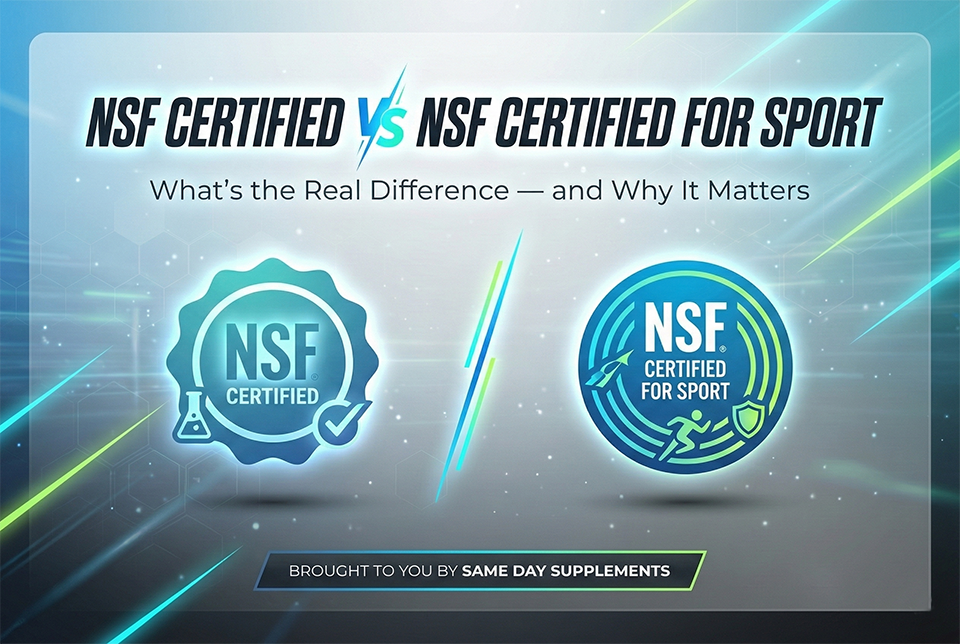
But “NSF Certified” and “NSF Certified for Sport” are not the same thing. They sound similar, yet they are built for different needs and testing priorities.
Practical note: If you’re not in a drug-tested sport, standard NSF certification may be enough. If you are drug-tested, you typically want a sport-focused program (like NSF Certified for Sport) because the risks are different.
Below, you’ll learn what the certification is, who awards it and how, what it does and does not guarantee, and how much it should matter when you choose a supplement.
📖 Table of contents
What NSF is and what the certification is
In the U.S., most dietary supplements are not reviewed or approved by the FDA before they are sold. That’s different from prescription drugs. (FDA/DSHEA: Questions and Answers on Dietary Supplements)
Because of that, quality can vary across products and brands. Third-party certification is one way companies can show that a product meets outside standards.
NSF is one organization that runs certification programs. If a specific product is NSF certified, it generally means the product met defined requirements related to things like ingredient identity, label accuracy, contaminants, and manufacturing controls—based on the program’s standards. (NSF: Product and Ingredient Certification)
Important: Certification applies to specific products (and sometimes specific forms or flavors), not an entire brand.
Who awards it and how it works
NSF is not a government agency. It is a third-party organization that offers certification programs. A company chooses to apply for certification and, if accepted, agrees to meet the program’s standards and oversight requirements. (NSF: Dietary Supplements and Nutritional Products)
While the details vary by program, certification commonly involves a combination of:
- Review of the product label and formulation against program rules
- Testing for certain contaminants and for ingredient identity/potency
- Ongoing requirements (which can include periodic testing and audits)
That oversight is what separates “certified” from a one-time lab test a brand might commission on its own.
What NSF certification typically checks
When a supplement is NSF certified (under an NSF supplement program), the goal is usually to reduce common quality problems: incorrect ingredients, incorrect amounts, and avoidable contamination. (NSF: Product and Ingredient Certification)
1) Ingredient identity
Testing can help confirm that key listed ingredients are actually present, rather than swapped, diluted, or replaced.
2) Potency (amounts)
Testing can check whether the amounts on the label are reasonably close to what’s in the product. This matters because too little may make a product less useful, while too much can raise tolerability or safety concerns—especially for stimulants, fat-soluble vitamins, or high-dose minerals.
3) Contaminants
Programs commonly include screens for contaminants that can happen during sourcing or manufacturing, such as certain heavy metals or microbes. The exact panel depends on the program and product category.
How to use this: Think of certification as a quality-control signal, not a promise that the supplement is “safe for everyone” or “right for your goal.” It lowers certain risks, but it doesn’t remove all risk.
What NSF Certified does not mean
This is where many people get misled (often unintentionally) by how logos look on packaging.
- It is not FDA approval. The FDA does not approve most supplements before sale, and NSF is not the FDA. (FDA/DSHEA: Questions and Answers on Dietary Supplements)
- It does not prove effectiveness. A quality-certified product can still be underdosed for your needs, use ingredients with weak evidence, or be a poor fit for your goal. Certification is about quality controls, not performance outcomes.
- It does not guarantee you will never have side effects. Even accurate labels can include ingredients that interact with medications, aren’t appropriate in pregnancy, or cause issues in sensitive people. If you have medical conditions, take prescription meds, or are pregnant/breastfeeding, it’s smart to check with a clinician.
- “NSF Certified” is not automatically “drug tested.” Banned-substance screening is tied to sport-focused programs (like NSF Certified for Sport), not to every NSF certification. (NSF: Certified for Sport® Program)
What NSF Certified for Sport adds
This is where the two certifications diverge.

NSF Certified for Sport includes everything covered under NSF Certified. But it adds extra testing for athletes and tested sports. (NSF: Certified for Sport® Program)
The biggest difference is the banned substance testing.
Certified for Sport products are screened for substances that are banned by major sports organizations. This includes organizations such as the World Anti-Doping Agency. (NSF: Certified for Sport® Program)
Even small traces of banned substances can cause problems. Sometimes this happens from cross-contamination during manufacturing.†
No certification can guarantee a drug test result, but Certified for Sport significantly reduces risk.†
Another key difference is batch testing.
NSF Certified for Sport products are tested batch by batch. That means each production run is checked, not just the original formula. (NSF: Certified for Sport® Program)
This matters because supplements are made over time. Ingredients come from different suppliers. Manufacturing conditions can change.
Batch testing adds another layer of protection. It helps make sure one clean batch doesn’t turn into a problem later.†
All of this extra testing takes more time and costs more money. That’s why Certified for Sport products are usually more expensive.
For everyday users, this level of testing is often more than they need. For athletes in drug-tested sports, it can be essential.
Why people look for NSF certification
Most shoppers aren’t looking for “perfect.” They’re looking for fewer unknowns.
People commonly seek NSF certification because it can:
- Increase confidence that the label matches what’s in the product (within program tolerances)
- Lower the risk of certain contamination issues
- Add transparency through public listings that you can verify
For drug-tested athletes, the motivation is usually different: reducing the risk of banned substances from contamination or adulteration. Research and case reports show that unintentional doping can happen through contaminated or adulterated supplements, especially in high-risk categories. (Article: Dietary Supplements as Source of Unintentional Doping)
NSF Certified for Sport vs Informed Sport
Once people learn about NSF Certified for Sport, another label usually comes up. That label is Informed Sport. (Informed Sport Program)

Both programs exist for the same reason. They help reduce the risk of banned substances in supplements.
Both programs:
- Test for banned substances
- Focus on athlete safety
- They are used by professional and tested sports organizations
The main difference is who runs the program and how the testing is handled.
- NSF Certified for Sport is run by NSF International. It combines product testing, facility audits, and ongoing batch testing. (NSF: Certified for Sport® Program)
- Informed Sport is run by LGC Group. It is best known for strong banned substance testing and batch certification. (Informed Sport Program)
From a practical standpoint, both labels are respected. Both are used by professional teams and tested athletes.
So which one is better?
In most cases, the answer is simple. Either one is a solid choice if you need banned substance testing.†
Key differences
| NSF Certified for Sport | Informed Sport |
|---|---|
|
|
Is NSF Certified for Sport worth the higher cost
Certified for Sport products almost always cost more. So it’s fair to ask if the extra money is worth it.
The higher price comes from extra testing. Batch testing takes time. Banned substance screening adds cost.
| Situation | Is the higher cost worth it? |
|---|---|
| Most everyday users | For most everyday users, the answer is usually no. NSF Certified already covers quality and safety. That’s enough for general health and fitness goals. |
| Performance expectations | Paying more doesn’t mean the supplement works better. It just means it was tested more. |
| Athletes in drug-tested sports | For athletes in drug-tested sports, the answer is often yes. The cost of a failed test can be much higher than the cost of the supplement. (Article: Dietary Supplements: A Gateway to Doping?) |
From a practical standpoint, if a failed test could affect your career, scholarship, or eligibility, the extra cost makes sense.
For people in between, it depends. If you want extra peace of mind, Certified for Sport can offer that. But it is not required for everyone.
Common misconceptions
I usually hear the same questions when people see an NSF logo. Here are the most common ones, answered simply.
1. Does NSF mean FDA-approved?
No. NSF Certified doesn’t mean FDA approved.
The FDA doesn’t approve supplements before they are sold. NSF is a third-party testing organization, not a government agency.
The logo means the product was tested. It doesn’t mean it was approved by the FDA. (FDA/DSHEA: Questions and Answers on Dietary Supplements)
2. Does NSF Certified mean drug tested?
No. NSF Certified products are not tested for banned substances by default.
Only NSF Certified for Sport includes banned substance testing. This matters for athletes in drug-tested sports.
3. Does having NSF certification mean the supplement works better?
No. NSF certification doesn’t improve results.
It only confirms label accuracy and basic safety. Effectiveness still depends on ingredients, dosing, diet, and training.
4. Do more certification logos always mean a better product?
Not always. More testing doesn’t always mean better performance.
For many people, basic NSF Certified testing is enough. The key is choosing the certification that fits your needs.
How to verify an NSF Certified product
-
- Use the official NSF listings. Start with NSF’s public database/listing pages for certified products. (NSF: Dietary Supplements and Nutritional Products)
- Search for the exact product name. Use the full label name. Small wording differences can point to different products.
- Confirm the certification type. Check whether it’s “NSF Certified” or “NSF Certified for Sport.” They are meant for different use cases. (NSF: Certified for Sport® Program)
- Match the form and flavor. Sometimes, only a specific flavor, dosage form, or version is certified. Match what you’re buying to what’s listed.
Third-party tested vs certification programs
You’ll often see supplement labels say things like “third-party tested” or “tested by ISO-accredited laboratories.” These claims are common and are usually intended to show that a brand takes quality and safety seriously.
What “third-party tested” means
In most cases, this means a brand sent a product to an independent lab for testing. This can include checks for ingredient identity, purity, or basic safety.†
Many reputable brands use third-party labs as part of their quality process. The exact tests and how often they’re done can vary by product.†
What ISO-accredited labs add
ISO accreditation applies to the lab, not the supplement. This means the lab adheres to standardized procedures, ensuring reliable test results.†
It doesn’t define what gets tested or require ongoing or banned-substance testing.†
How certification programs are different
-
-
- Testing standards are set by the certification program†
- Products are tested on an ongoing basis†
- Certified products appear in public databases†
-
Simple takeaway: Third-party testing shows a brand is taking steps toward quality. Certification programs add ongoing oversight and public verification. The right level depends on your goals and whether you compete in drug-tested sports.
Where to buy NSF Certified products
Looking to buy supplements with NSF certification? Whether you’re focused on safety, label accuracy, or peace of mind, buying from the right retailer matters.
You can find NSF Certified supplements at SameDaySupplements.com.
Here’s why many people choose SameDaySupplements:
-
-
- 🚚 Ships same day (Monday–Friday before 3 PM EST)
- ✅ Trusted U.S. retailer with verified customer reviews
- 💥 Bundle deals available on select supplements
-
For example, some NOW Foods products are certified through the Informed Sport program, while select Thorne products carry NSF Certified for Sport status.
This highlights an important point: certifications apply to individual products, not entire brands. Always verify the exact product, flavor, and form through the official certification databases.
Wrapping up
This concludes our review of NSF Certified, NSF Certified for Sport, and how these programs compare with common “third-party tested” claims.
Thanks for reading! As always, if something wasn’t clear, you have another question, or you’ve got an idea for a future blog, email us.
Looking to read more? Check out some other blogs:
Disclaimer
†PLEASE NOTE: The intention of the information provided is for reference only. Furthermore, we are in no way providing medical advice or instruction. Instead, the information provided in this guide/blog utilizes anecdotal information and available studies/reviews. While we aim to maintain and display accurate information, we can’t guarantee it represents the latest product formulation or information. Therefore, please visit the manufacturer’s website if you have any concerns. Also, the information above does not represent our views here at Same Day Supplements. Instead, these are the manufacturers’ and users’ views and information. The Food and Drug Administration has not evaluated these statements. Finally, these products aim not to diagnose, treat, cure, or prevent disease or illness. Logos shown for educational purposes only. Certification applies to specific products, not entire brands. Always verify certification status using official databases.